
Waukesha County Directory Collections
Official sources confirm several useful runs, but they do not publish one complete shelf list. The City of Waukesha historic survey cites a significant run at Waukesha Public Library and identifies examples from several eras. The National Archives confirms three years near the 1930 census. Library databases and archive series add context when a volume is missing.
The National Archives city-directory guide provides a direct check on those census-era years.
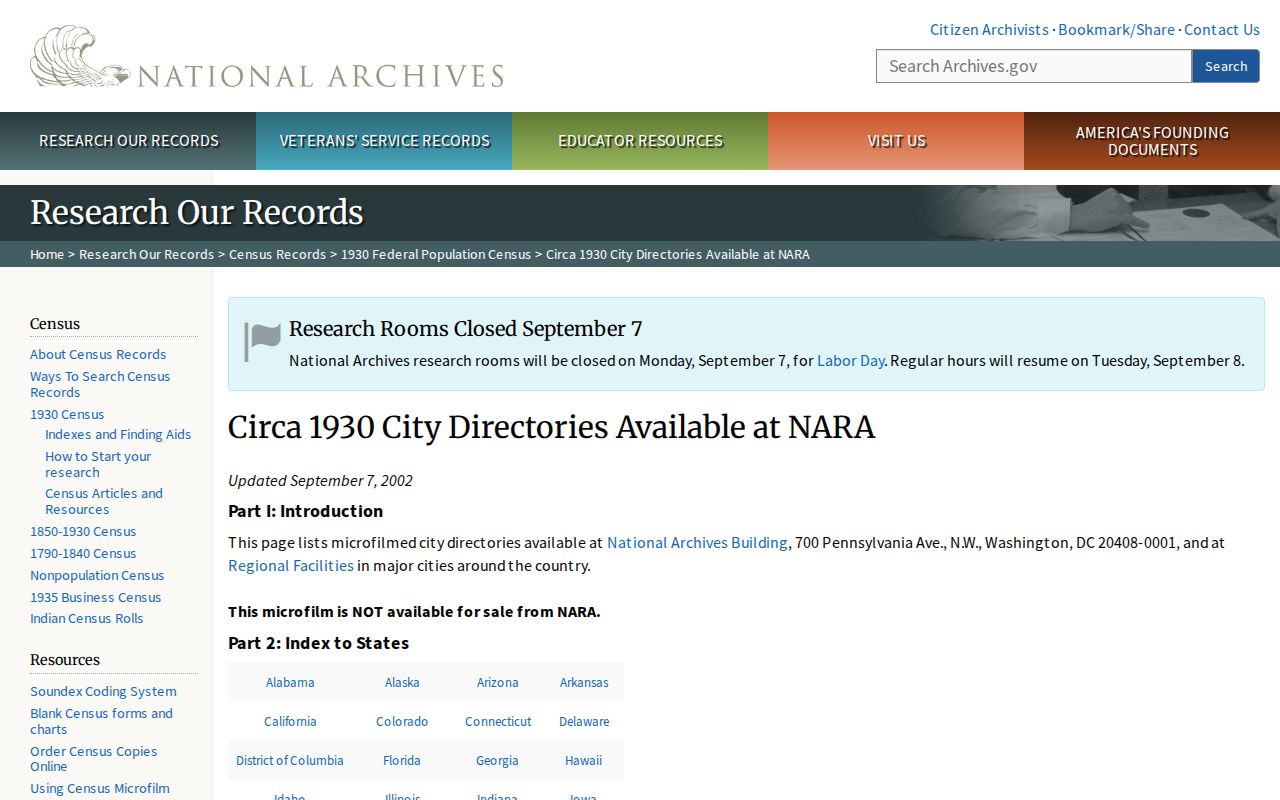
The captured guide supports the 1929, 1931, and 1934 entries, while Waukesha Public Library remains the source for its full local run.
| Collection | Years | Where Held | Access |
|---|---|---|---|
| Waukesha City Directory, various publishers | 1929-1946 samples; 1981; 1991-1992; 2002 | Waukesha Public Library | Ask Adult Reference for exact holdings |
| National Archives listing | 1929, 1931, 1934 | National Archives research path | Year confirmation; not a full run |
| FamilySearch Affiliate records | Collection-specific | Waukesha Public Library | Free account; in-library access |
| Newspapers and HeritageHub | 1884-current; 2000-current; obituaries 1704-present | Library databases | Remote access |
The evidence does not establish every year, a last printed year, call numbers, or exact reverse-directory coverage. A gap on a public list does not prove a book never existed. Call Adult Reference at 262-524-3682 to verify a year and format before travel.
Waukesha City Directory Library Access
Waukesha Public Library's database page is the first stop for the local shelf and its digital companions. The library is at 321 Wisconsin Ave. Adult Reference can check directory years, microfilm, reverse volumes, and staff help. Listed hours are Monday through Thursday 9 a.m. to 8:30 p.m., Friday 9 a.m. to 6 p.m., and Saturday 9 a.m. to 5 p.m.; Sunday is closed. Confirm before a visit.
The page verifies FamilySearch Affiliate access to more than 350 million added digital records from inside the library. Remote resources include the Milwaukee Journal Sentinel from 1884, Waukesha Freeman from June 2000, and HeritageHub obituary material.
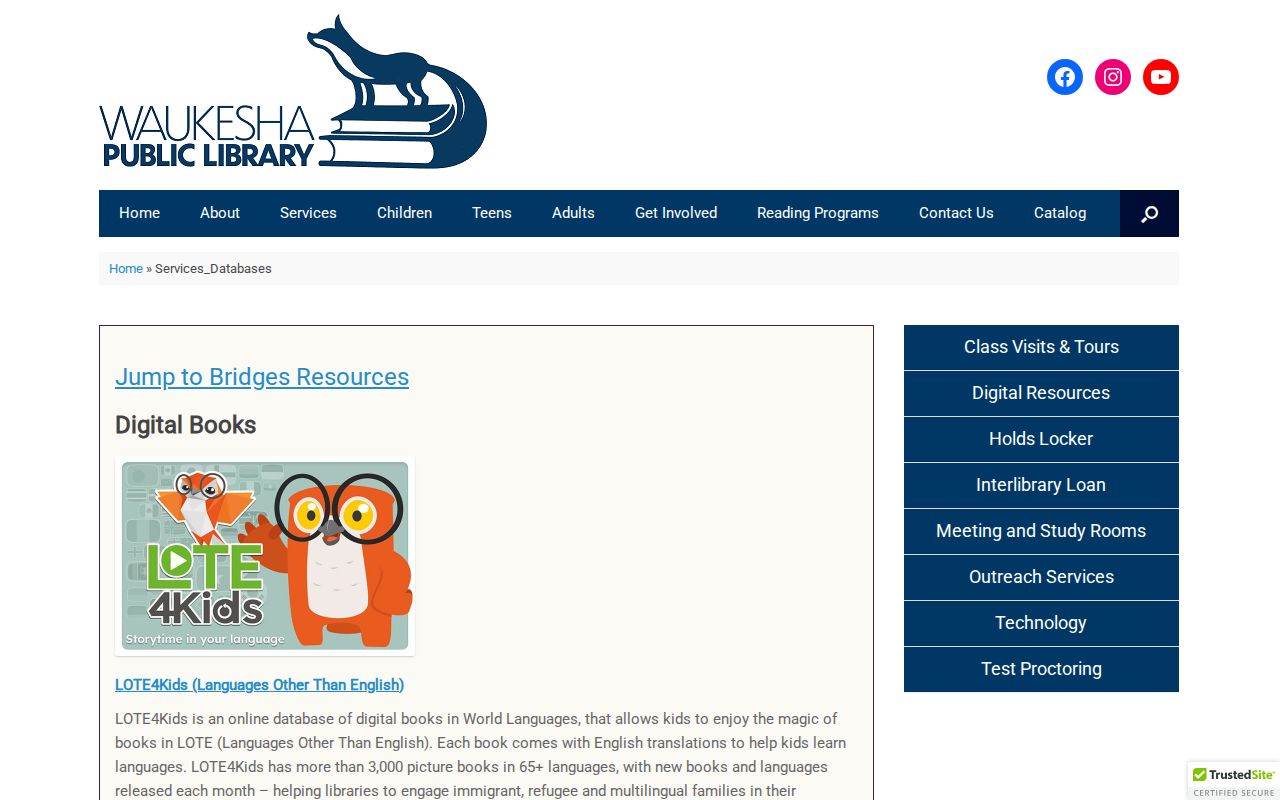
The captured page shows how a directory name can move into newspaper, obituary, and family-history checks.
Waukesha Directory Meets 1871 Map
The Wisconsin Historical Society's 1871 map bridges an older lot-based town with later street listings. It shows roads, rail lines, lot numbers, plat additions, owners, schools, churches, buildings, and business-directory material. Use it when a later house number cannot be projected safely onto an early parcel.
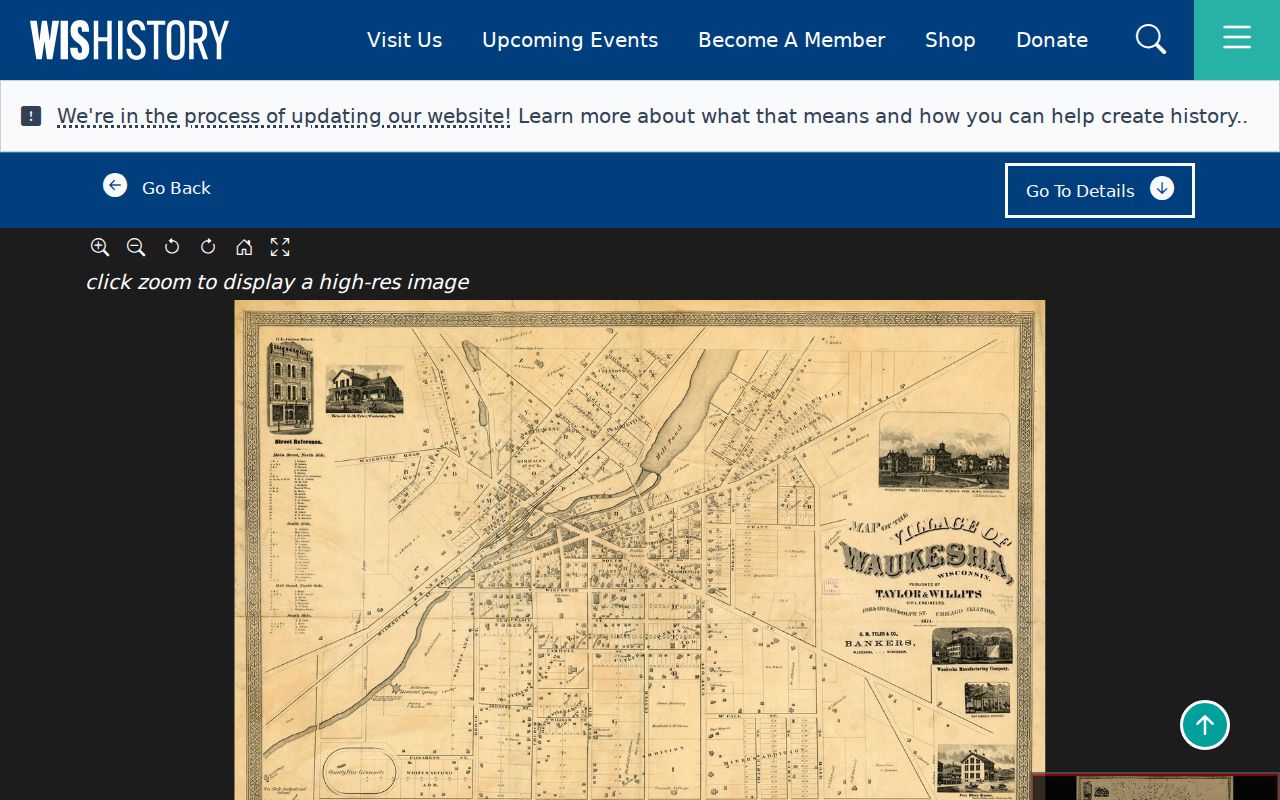
The map keeps the lot, road, and landmark context that a name-only city directory search may miss.
Waukesha County Historical Research Desk
The Huelsman Family Research Center works by appointment at 101 W. Main St. on Wednesday 9 a.m. to noon and Friday 9 a.m. to noon and 1 to 4 p.m. Contact 262-521-2859 extension 225. Nonmember sessions cost $20, student sessions $5, and remote research $20 per hour. Copies are 25 cents for letter-size black-and-white, 50 cents for oversized or color, and $5 for a PDF scan of up to 75 pages.
The historical society reports more than one million documents and 15,000 artifacts. Send staff a surname, year range, municipality, address, and known relatives. Museum exhibit hours differ from research-center hours.
Read a Waukesha City Directory Entry
No populated local page was captured, so no abbreviation should be assumed. Photograph the title page and abbreviation key with the entry. Record each printed field exactly, including punctuation and symbols; a transcription can introduce errors.
| Name | Surname and given name; another name may appear in parentheses |
|---|---|
| Work | Occupation and sometimes employer, only when printed |
| Address | Street and house or apartment number in that edition's format |
| Status mark | Owner, renter, householder, or residence code if the key defines it |
| Source | Title, publisher, year, page, image location, and access date |
- Criss-cross directory
- A later section arranged by street address rather than surname. Local coverage must be confirmed.
- Householder index
- A list centered on the identified household head, which may omit others at the address.
- Abbreviation key
- The publisher's code list for that edition. It controls how printed marks should be read.
Waukesha Directory Names in Archives
UWM's genealogy guide routes researchers to Waukesha Series 31 grantor and grantee indexes and Series 32 deeds from 1839 through 1885. The indexes run by surname and transaction order. One local wrinkle matters: volumes A through G, from 1839 through 1855, were recorded in Milwaukee County. A gap can point across the modern county line.
Waukesha Circuit Court naturalization material spans 1847 through 1955. It includes declarations, petitions, certificates, indexes, and related papers. Statewide marriage microform spans 1852 through 1907. These may confirm identity or kin, but not continuous occupancy at a home.
Waukesha Directories Beside Permit Dates
The City historic survey uses city directories beside building permits, Sanborn-Perris maps, plats, and historical property files. A directory dates a printed person-address link. A permit dates work and may name an owner. A map tests whether the building and street existed. Together they corroborate a chronology.
Specific local Sanborn years were not confirmed. Request the exact sheet and edition. Use the Waukesha County street directory workflow for modern address-keyed records.
Waukesha Directory Research Timeline
Known milestones help choose the right source without pretending the run is complete.
| 1871 | Village map records lots, owners, roads, and buildings. |
|---|---|
| 1929, 1931, 1934 | National Archives confirms directory years near the census. |
| 1929-1946 | City survey cites various dates in this span. |
| 1981-2002 | Survey cites 1981, 1991-1992, and 2002 examples. |
The survey reports City of Waukesha growth from about 18,000 people after World War II to 39,695 by 1970. New streets and subdivisions help explain sharp changes in later volumes.
Trace Family Through Waukesha Directories
Build a year-by-year log. Keep the exact printed address and spelling, since a person can move or two people can share a name. Census records give a broad check, while papers, obituaries, deeds, and permits can narrow events between census years.
- Find the earliest verified appearance and record title, year, page, spelling, and address.
- Check nearby editions in both directions, noting moves and missing years.
- Ask whether a reverse section exists, then inspect the street context.
- Compare the nearest census, plat, deed index, and permit date.
- Use local papers, HeritageHub, or cemetery records to explain the trail's end.
Disappearance proves little. The person may have moved, died, changed a surname, been omitted, or fallen into a missing volume. Keep the reason unknown until another dated source supplies it.
Confirm Waukesha Directory Finds
A printed name and address should be checked against a second dated source. Search the Waukesha Freeman for local notices from June 2000 forward, then broaden to the Milwaukee Journal Sentinel collection for regional reporting from 1884 forward. HeritageHub reaches obituary and death-notice material from 1704 to the present across all states. Original images are available for some results, but a search hit is not proof that the person lived at the Waukesha address.
Use a tight date window around the directory year. Search surname variants, spouse names, the exact street, and an employer if the entry prints one. An obituary can explain a household change and name kin. A business notice can explain an occupational line. Save the publication, date, page, and image with the directory citation. When two sources disagree, keep both readings and look for a deed, permit, census page, or vital record that resolves the conflict.
Place Names in Waukesha Directories
Waukesha can mean the county, the county seat, the city, or the post-office name printed in a source. The county contains 34 municipalities. A historical name may also point to a village, town, ward, plat, or postal place that does not match current borders. Keep the municipality and post office in separate fields, especially when comparing an old directory with today's parcel systems.
For early records, ask what the street was called, which lot and plat applied, and whether the building stood in that year. Test road-type abbreviations and directional variants. The old courthouse history also explains why papers described as courthouse records may now appear at a county office, archive series, library, or the Huelsman center. The building at 101 W. Main St. dates to 1885, with additions in 1893 and 1938; county functions moved in 1959. That history is context, not evidence of a lost-records disaster.