
Waukesha Previous-Resident Sources by Era
Start with the newest reliable parcel identity, then choose the source that covers the next period. Waukesha County's record trail is uneven. The modern recorder index has a clear starting year, while older repository material and local directory holdings need a book, finding aid, or staff search. The era table shows what can be claimed and where a gap still exists.
| Source | Years It Covers | Where Held | What It Shows |
|---|---|---|---|
| County online deed index | 1994 to present | Register of Deeds public access | Indexed instruments tied to a legal description or tax key; tax-key links are not complete |
| Older recorder material | Documents back to 1953 are described; full index span unstated | Register of Deeds office and index books | Pre-1994 ownership trail requiring book, index, or staff access |
| WHS deeds and indexes | 1839 to 1885 | Wisconsin Historical Society Series 31 and 32 | Grantor/grantee index and deed books; early volumes carry a Milwaukee County wrinkle |
| Waukesha city directories | Examples from 1929 to 1946, plus 1981, 1991-92, and 2002 | Waukesha Public Library and cited archives | Published address, household, and occupation clues; complete run not verified |
| Federal census | Public schedules through 1950 | National Archives and genealogy access | A household snapshot by enumeration geography under the 72-year release rule |
| Building permits | Portal coverage not stated | City of Waukesha or the relevant municipality | Project, parcel, issue date, original owner, and site address |
| Newspapers and obituaries | Journal Sentinel 1884 onward; Waukesha Freeman June 2000 onward; HeritageHub 1704 onward | Waukesha Public Library databases | Published moves, sales, estates, family links, and death notices |
For recent previous residents, begin with the current parcel, recorded deeds, and permits. For the early and middle twentieth century, use a directory year beside a released census year. Nineteenth-century work leans on deed books, plats, maps, newspapers, naturalizations, and archive help. Exact reverse-directory runs and Sanborn map sheets were not confirmed, so do not assign an occupant or building date from those sources until the actual volume or sheet is inspected.
Anchor Waukesha Previous Residents
The modern parcel is the stable end of a backward search. Enter the address in Waukesha County Tax Listing, save the tax key and parcel description, and then inspect the same shape in Map Atlas. Record the civil division, legal description, ZIP, source date, and layer name. A tax mailing address that differs from the situs, or property address, may indicate an agent, trust, former address, or owner who receives mail elsewhere. It does not identify the occupant.
Historic-tax-parcel, annexation, civil-division, and retired-plat layers can explain a broken link. The county GIS service describes historic parcels extending to about the mid-2000s, though exact dates depend on layer metadata. Tax keys can change, and GIS geometry is not legal title. Preserve the legal description whenever possible because it can bridge a changed tax key or street label.
Note: Save both the parcel address and legal description before moving backward, since either one may disappear from an older index.
Trace Waukesha County Owners Backward
The chain of title is the sequence of recorded transfers affecting the same land. Begin with the current parcel rather than a surname. The Waukesha County Register of Deeds public-access system allows remote legal-description searches after its acceptance screen. Its guide states that remote name search is restricted, while name searching is available in the office. That makes the parcel, subdivision, lot, Certified Survey Map, or section-township-range description central to remote work.
- Copy the current parcel's tax key and full legal description from tax and map records.
- Use GIS Map Search or the matching legal-description mode to find the current acquisition instrument. Save the instrument or book/page, recording date, document type, parties, and image reference.
- Identify the seller, then find that person's earlier acquisition. At the office, search the seller as a grantee, meaning the person who received the property.
- Repeat while the legal description remains consistent. Treat mortgages, easements, satisfactions, liens, and affidavits as context, not automatic ownership transfers.
- At the 1994 online cutoff, move to index books, older repository tools, or staff help. For 1839 to 1885, use Wisconsin Historical Society Series 31 and 32.
- Grantor and grantee
- The grantor transfers an interest; the grantee receives it. The roles reverse when following one owner to an earlier purchase.
- Chain of title
- The linked sequence of recorded transfers for the same land.
- Legal description
- The formal lot, survey, or section description used in land records. It often lasts longer than a street address.
The GIS route shows only documents associated with the tax key. No result can mean a missing tax-key link. It is not proof that no deed exists. Purchased images may remove a watermark, but an index entry still needs comparison with the original document when a precise ownership fact matters.
Waukesha's Milwaukee Deed Wrinkle
Waukesha County separated from Milwaukee County in 1846, but the early deed books do not split cleanly at that date. The UWM genealogy guide identifies Waukesha Series 31 grantor/grantee indexes and Series 32 deeds for 1839 to 1885. Volumes A through G, covering 1839 to 1855 and including federal land patents, were recorded in Milwaukee County.
This is a useful local trap to know. A missing early Waukesha deed may sit in a book whose recording context points to Milwaukee County. Search the index and deed series, keep the book letter and page, and compare the land description. Do not bridge a missing link by surname alone. Two owners can share a name, and one owner may have held several parcels.
Bridge Waukesha Lots to Addresses
The Wisconsin Historical Society's 1871 map combines roads, railroads, lots, owners, buildings, public sites, and business-directory material. The image below shows the captured map resource. It can bridge a deed's lot or plat language to a later street address when house numbers are absent or no longer match.
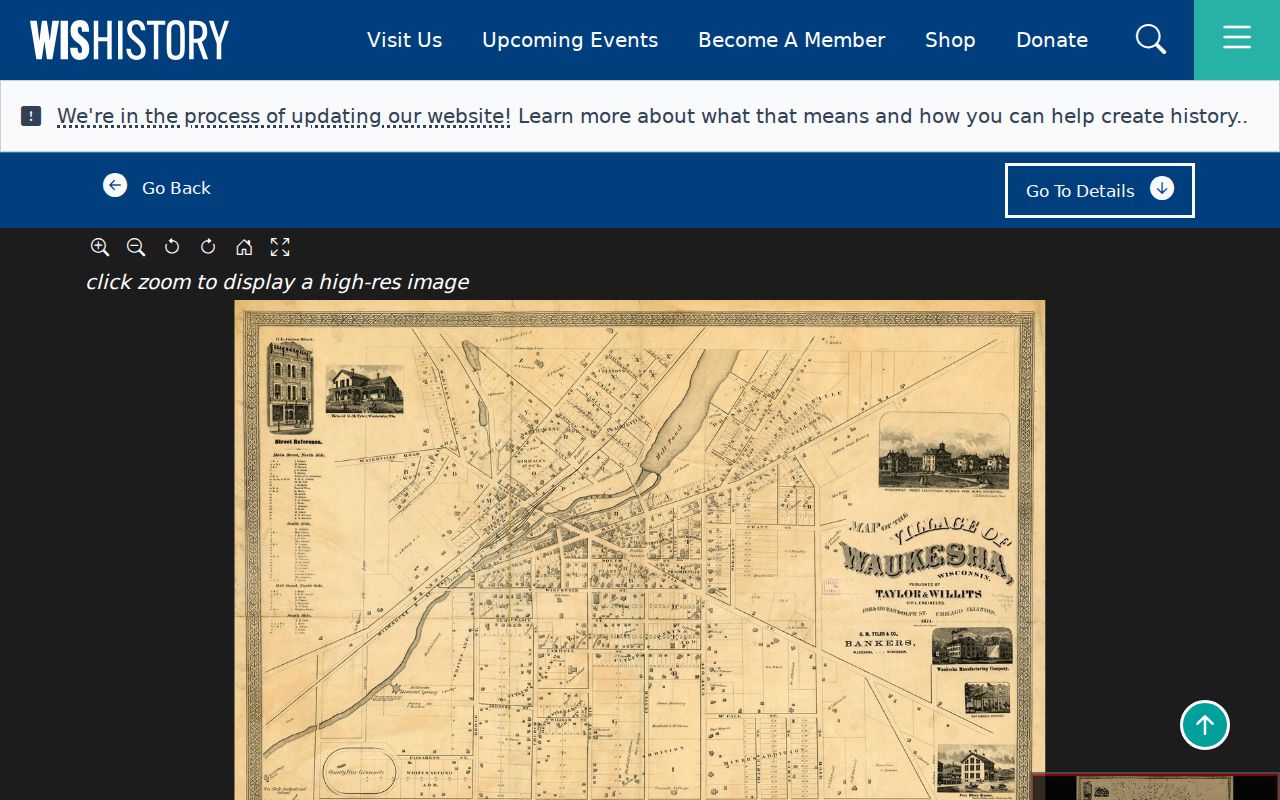
Use the map as dated evidence. An owner's name on an 1871 parcel does not prove that person lived there, and a building shown then may not be today's structure. Compare lot, block, road, neighboring owners, and later parcel geometry before calling the match confirmed.
Pair Waukesha Directories and Census
Deeds follow owners. To find previous residents, move from the property chain to household sources. The City of Waukesha historic survey cites directory years within 1929 to 1946 and later examples from 1981, 1991-92, and 2002. The National Archives separately confirms Waukesha directories for 1929, 1931, and 1934. These are verified examples, not a complete shelf list. Exact criss-cross runs still need library confirmation.
- Choose a directory year nearest a known deed, permit, census, or newspaper date. Search both the address and the suspected surname if the volume supports those arrangements.
- Copy the entry as printed, including spouse, occupation, abbreviation, street direction, and page. Do not expand an unclear mark from memory.
- Compare the address with the released federal census nearest that year. The 1950 census is the latest public federal schedule under the 72-year rule.
- Match household names, ages, relationships, ward or enumeration area, and nearby addresses. A directory and census match is stronger than either source alone.
- Repeat in the next available year. Mark the person as confirmed, likely, possible, contradicted, or not located based on the evidence.
The full publication holdings belong to the Waukesha County city directory collections. For an address trail, use only the specific year and page needed to test occupancy. Missing years, spelling changes, and rebuilt structures can interrupt the sequence.
Waukesha Library House-History Paths
Waukesha Public Library databases include FamilySearch Affiliate access, the Waukesha Freeman from June 2000 onward, the Milwaukee Journal Sentinel from 1884 onward, and HeritageHub obituaries and death notices reaching back to 1704. The captured database page below confirms the library entry point. Access rules vary: some databases work remotely with a card, while affiliate material may require an in-library session.
Search the full address, surname, street variants, and words such as sold, moved, estate, married, and obituary. Then open the original page and record its date. OCR, the machine-read text used to search scans, can miss old type or split a grid address.
The Huelsman Family Research Center fills gaps with finding aids, family and property material, newspapers, maps, photographs, and courthouse sources. Research is by appointment. The research center lists a $20 nonmember session and remote research at $20 per hour, with copy costs on its page.
Date Waukesha Homes with Permits
The City of Waukesha permit search accepts a parcel ID, site or mailing address, issue-date range, original owner, owner name, permit number, type, and status. Results can display Permit, Parcel, Issued, Owner(s), and Site Address. The city's historic-property survey confirms that permit dates and city directories were used together to interpret buildings.
A permit can show when work occurred and name the person or firm tied to that project. It does not establish who lived there. Portal coverage is not published, so request older records from the municipality when the online search is empty. For a parcel outside the City of Waukesha, first identify the city, village, or town in the county map.
Note: A permit owner, deed owner, directory householder, and census resident may be four different roles at the same address.
Label Gaps in Waukesha House History
A backward trail often breaks at an unindexed deed, missing directory year, changed address, annexation, rebuilt house, spelling variant, or private family record. Keep a worksheet with historic and modern street names, house number, direction, road type, ward, lot, block, municipality, post office, ZIP when known, map source, and confidence. Add the retrieval date for each portal.
Use clear confidence labels. Confirmed means two strong records agree on the parcel and person. Likely means the facts align but one link remains. Possible is a lead. Contradicted means another source conflicts. Not located reports the search without turning silence into a fact. This restraint matters because no single Waukesha County source establishes continuous residence.
Confirm Waukesha County Past Households
Close the trail by asking whether separate records describe the same person and parcel. A directory places a printed name at an address in one year. A census may show relationships in one census year. A newspaper can report a move, sale, marriage, estate, or death. Naturalization records from Waukesha Circuit Court for 1847 to 1955 can add chronology, but they are not modern address records. Vital records can connect relatives and dates under Wisconsin access rules, yet a family link alone does not prove residence at the target house.
Obituaries and probate files can explain why a resident disappears from later sources or why a transfer involved an estate. Search the court index and newspaper, then verify the original record. Sealed cases, restricted vital facts, and private family data remain protected. Publish only the narrow fact needed for a lawful house or family history.
Lawful use. Research previous residents for house history, genealogy, estate work, or personal curiosity. Do not use old or current address facts to track, harass, or expose a living person.
Safe at Home assigned addresses and confidential-elector protections must be honored. Do not reverse-engineer a protected location from deeds, court filings, voter material, or GIS. The strongest finished chain is transparent about both evidence and gaps.